
Roberts on Raptors
Many of you know Paul Roberts and have benefited from his wisdom and advice about raptors. For many years Paul has published his thoughts and stories about hawks in general and the Mystic Lake eagles in particular on various email listservs, such as MassBird and ArlingtonBirds.
We are very pleased that Paul has agreed to allow us to offer his raptor writings on the BBC website. We will treat this recurring feature like a blog, appending the newest installment at the top of the page.
Think Migrating Golden Eagles
The weather forecast for this Saturday (October 17) suggests birders should brush up on their eagle identification.
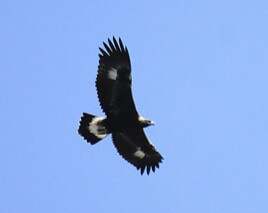
A powerful cold front is forecast to dominate our air space Saturday with chilly powerful northwest winds gusting at 30 mph for at least one day. We have a decent opportunity to see one or more Golden Eagles in Massachusetts and environs.
Roughly 5,000 Golden Eagles are estimated to breed in eastern Canada (~ 1250 pairs and a roughly similar number of non-breeding birds, birds largely 6 mos to 5 years old.) “Spaghetti maps” showing the flight paths of radio-tagged Golden Eagles indicate that most Golden Eagles use the Appalachian Ridge as their basic migration route. Tag data suggests that most adults do not leave their breeding range until mid-October, so late October and early November are the best times to see adult Goldens migrating over relatively direct inland routes. Immatures (it can take five years for a Golden to achieve breeding plumage) including juveniles (hatch-year birds) tend to migrate a little earlier and over a broader front, giving Mass birders their best opportunities in state.
Historically, relatively few Goldens are reliably reported in Massachusetts, especially the eastern portion. The Berkshires, especially the Mount Everett area, may still offer the best opportunities to see Goldens in the Commonwealth. Immatures are less knowledgeable migrants and juveniles have never done it before, so they really don’t know exactly where they are going or how to get there, much less when. They wander and dally, so are more inclined to fly east towards the Atlantic coast, especially on powerful, cold, northwest winds. Normally, most Goldens are reported in New England in the second half of October and first half of November. On October 12 Clarry Hill in eastern Maine reported three early adult Goldens, essentially migrating together. Eagles have significant wing loading and are among our most powerful, stable fliers. In other words, if you want to see a Golden Eagle, Saturday is a great opportunity, when it may be difficult to see most other birds in the air or on the water.
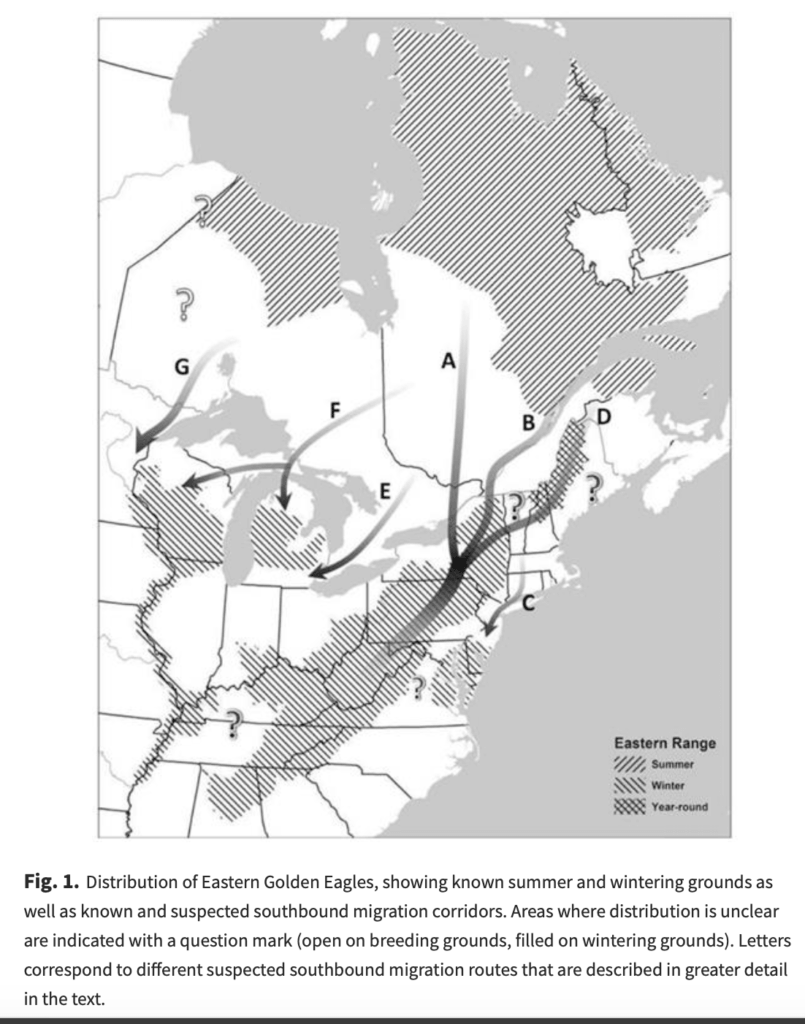
From“Status, Biology, and Conservation Priorities for North America’s Eastern Golden Eagle (Aquila chrysaetos) Population,” Katzner, et.al… The Auk, Volume 129, Issue 1, 1 January 2012, Pages 168–176, https://doi.org/10.1525/auk.2011.11078.
The birds are likely to be flying northeast to southwest inland , paralleling our coastline. Wachusett is probably the best site in eastern Massachusetts, though 30+ mph winds may keep most other raptors, and possibly the Goldens, flying lower than the 2006’ summit. If nothing is seen from the summit, try the North Rd. Overlook. Mt. Watatic in Ashburnham, which requires a hike, is a great ridge site. Mount Agamenticus in southeastern Maine is another good observation point (you can drive to the summit). But anywhere is possible. Several decades ago, in the early days of MassBird, I recall a report of a Golden Eagle flying over Medford Square, a mile from my home. I was skeptical of the report until I got a report about an hour later of a Golden seen well by experienced observers in the Blue Hills. The bird was flying down Route 93!
Many “Golden Eagle” reports in October are likely juvenile Bald Eagles. They can be as large as Goldens, and very dark, often with dirty white patches in the tail (and telltale white wingpits). Immatures can have light necks and crowns, suggesting a Golden’s hackles. Thus, it pays to review the basic differences. (See the Maine Eagle Identification Sheet.)
Bald Eagles have large heads and beaks in front of the wings, and a long tail behind. Goldens have a comparatively small head and beak in front of the wings, and a long tail, so the silhouettes are distinctly different. Bald Eagles tend to look like a flying plank, a “2 X 4,” soaring on flat wings. Goldens look more “buteo-like,” with the hand raised and pushing slightly forward in a Redtail-like shallow dihedral. The trailing edge of the wing narrows noticeably at the body.
If contrast can be seen, immature Bald Eagles can have irregular dirty white virtually anywhere on the wings or body, and for the first several years have clearly dirty white wingpits. It takes Bald Eagles a minimum of three and for most birds four plus years to achieve a crisp refrigerator-white head and tail. Adult Golden Eagles have no crisp white anywhere (except rarely on the base of the tail). Immatures can have crisp clean bright white patches at the base of their flight feathers on the wings and tail, above and below, that diminish gradually. In recent years it has been learned that contrary to most older field guides some immatures, including juveniles, lack any white in the wings and will have only clean, crisp white on the base of the trail. The famous golden hackles are often difficult to see, especially in ashen November skies.
In recent decades we’ve also learned that eastern Golden Eagles behave differently from western birds, especially during the winter. Western birds are often easily seen in wide open spaces hunting ground squirrels, prairie dogs, and jack rabbits. Eastern birds find few such areas, evolving to hunt and scavenge beneath the canopy, where they are much more difficult to see. Our best opportunities to see them are in migration.
A visit to www.hawkcount.org to look for Golden Eagle counts at hawkwatches in New York, New Jersey and Pennsylvania, will reveal numerous sites within 300 miles to see significant numbers of migrating Goldens in the month ahead.
Are Kites Breeding in New England for the Long Haul?
Merlins are extending their breeding range south and east in New England, Red-shouldered. Cooper’s Hawks and Black Vultures are extending their ranges north in contiguous fashion. However, two southern species of raptors have been extending their breeding range north into New England in leap-frog fashion.
First was the surprising broad-front northward range expansion of Mississippi Kites late in the first decade of the 21st century. That included a small colony established in coastal New Hampshire, with isolated nests documented in Connecticut, New York, and a few other northern states. None of those “populations” has to my knowledge grown significantly in almost two decades, though Mississippi Kites are continuing to extend their contiguous breeding population northward in Missouri and Illinois.
The biological interest in Mississippi Kites has largely focused on their dramatic shift in breeding habitat for many from rural to urban/suburban environments, including parks, cemeteries, golf courses and reservoirs. You might recall that Red-tailed Hawks made a similar habitat/range expansion in the late 20th century. The urbanization of raptors has become a leading theme.
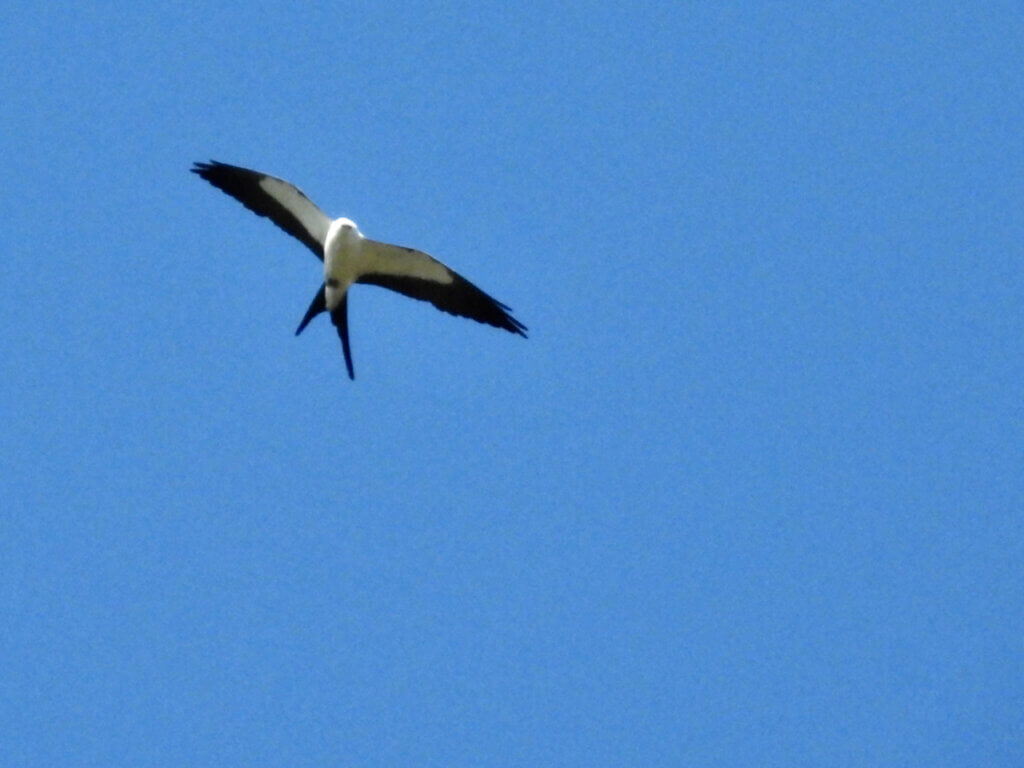
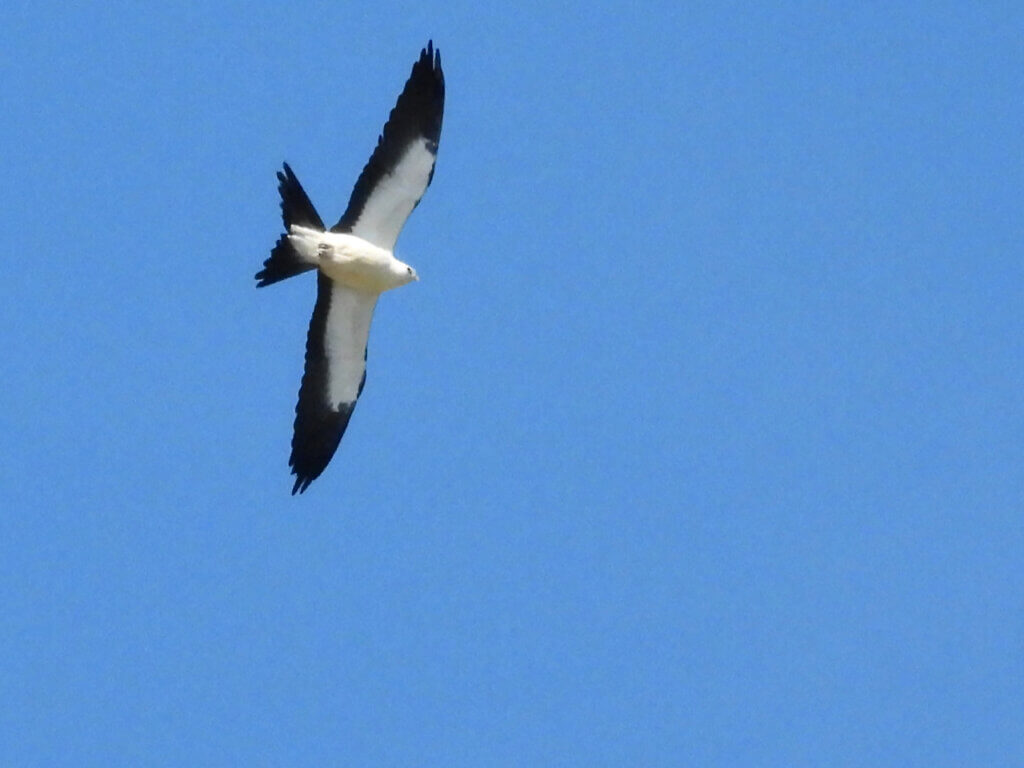
Last year Peter Trimble confirmed Mississippi Kites nesting on the Cape. This year in late August he confirmed that at least two Swallow-tailed Kites fledged on Cape Cod, the first north of apparently a lone pair breeding in North Carolina.
The Cape has seasonally hosted largely immature (non-breeding) kites of both species at times over the past half century (and even a Swainson’s Hawk.) The kites usually arrive “early” in late March or late in late May on unusually strong warm fronts. These are largely immatures returning from South America and wandering until their second “fall” migration. For the past several years Swallow-taileds have been spotted on the Cape during the summer.
In 2025 both kite species were seen regularly on the Cape in small numbers. Did non-breeders who spent last summer on the Cape find food (primarily 17-year cicadas) so abundant that they returned this year and were able to breed successfully without the cicadas? Was it just one pair of Swallow-taileds, or possibly two? What about the multiple Mississippi Kites? Did one or more pairs breed successfully this year?
The initial nestings raise questions about establishing sustainable breeding populations in the state. A key question for both species is that, beyond the northern limits of their current range, can they fledge young early enough for them to migrate south and return north successfully two years running? The two species are our earliest long-distance migrant raptors, spring and fall. Many raptor species’ juveniles put on more weight than adults to help sustain them during their initial dispersal, prior to lengthy migration travel. Can young northern kites, hatching and fledging somewhat later than their southern counterparts, successfully regularly migrate “later and longer” than their southern counterparts?
Surprisingly little is known about both kites migration to South America. We have not yet had three-digit Broadwing flights in New England but most of the Mississippi and Swallow-tailed Kites in the southern United States have already left the country on their “fall” migration. [Editor: This piece was written in early September, prior to the Broadwings migration flights later in the month.] Their accounts in Birds of the World are over a quarter-century old, with surprisingly sparse migration information and no telemetry data.
The New Hampshire Mississippi Kites arrive in early to mid-May and therefore start nesting later than most Mississippi Kites. When their juveniles fledge, they start the land-based migration south somewhat later than most of their species. Steve Mirick reports that adults care for their young “into the first or second week of September and then all birds seem to disappear at once.” (The latest observation is September 11.) Over 145,000 Mississippi Kites had migrated past the Corpus Christi Hawkwatch in Texas before September 1, 2026. 136,000 more passed in the first four days of September. This suggests that New England’s juvenile kites might not disperse before beginning migration, which likely reduces their breeding productivity and population growth.
The peak Mississippi Kite flights reach Chichicaxtle, Mexico, the first ten days of September. Chichi had a record 535,697 Mississippi Kites last year. Cardel, Mexico, not far away, has its largest Mississippi Kite flights between August 27 – September 4. Mississippi Kites are just beginning to reach Bocas Loma Azul, a new hawk watch site in Caribbean Panama, in early September (36,000 by 9/5). New Hampshire kites are likely still in the “Live Free or Die” state.
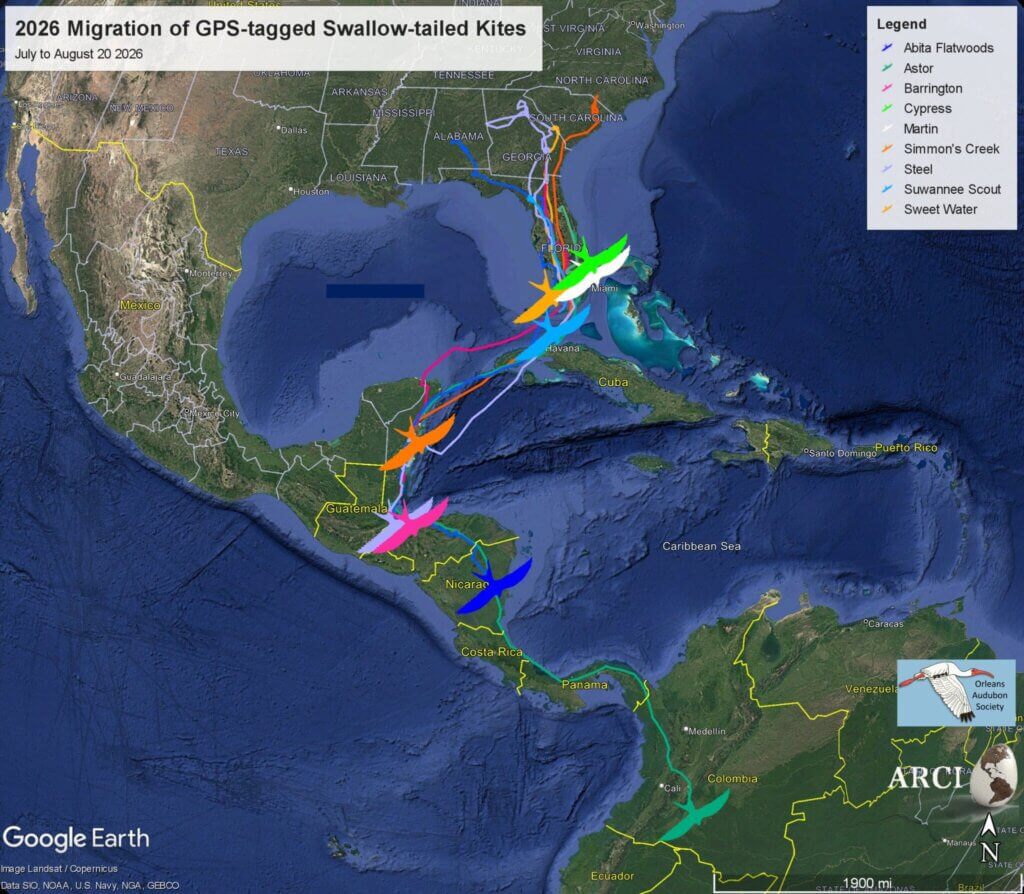
Swallow-tailed Kites are even earlier fall migrants. The bulk of the Swallow-tailed population arrives in March and leaves Georgia and Florida in August, often first assembling in 3- and 4-digit numbers in premigration roosts that can become feeding frenzies. They then depart, often very early in the day (before hawk watch sites are covered), over the Caribbean. They are quite vulnerable to sudden changes in winds that cause many to make landfall in lower Central America before continuing overland south to Brazil. The Avian Research and Conservation Institute (ARCI) recently has been implementing a challenging radiotagging program on these light, slender birds to document their migration paths and wintering grounds.
The Corpus Christi Texas Hawk hawkwatch averages only 130 Swallow-taileds a year, with a maximum of 383 in 2022. These are largely the small population that breeds in Texas and Louisiana. Chichicaxtle’s largest annual count was only 282 (2024), with Cardel’s average 487 birds. Meanwhile, Bocas Loma Azul in Panama had 36,000 Swallow-tailed Kites pass before September 5! Panama’s count is so much higher than Mexico’s because most of the U.S. population, largely in the southeast, migrate across the Caribbean in August. They tend to head directly for Brazil, though many make landfall in Central America well south of Veracruz. This August, Chichicaxtle totaled 160 Swallow-taileds and Bocas Loma Azul tallied 12,977.
Peter Trimble confirmed Swallow-tailed Kite breeding on the Cape when he saw an adult feeding a begging young bird. Four Swallow-tailed Kites, 2 adults and two presumed juveniles, were seen as late as August 26, and two apparent adults August 31. Thus we might presume northern juvenile Swallow-tailed Kites likely do not disperse – becoming fully independent – before beginning a “later and longer” migration. As with New Hampshire’s kites, this is likely to reduce their overall productivity and population growth.
We won’t have reasonable answers on the kites ‘success for at least ten to twenty years. Mississippi Kites lay 1-2 eggs on average; Swallow-tailed Kites lay 2 but lay up to 4. Few if any breed as yearlings, so it takes at least 2 and possibly 3 years for the first successful nesting. If mortality is in the vicinity of 50% in the first year, population growth can be very slow indeed.
I am fascinated that these new Massachusetts breeders belong to the two raptor species that vacate the U.S. before any others. I can easily understand why raptors in the far north migrate long distances because their prey, from insects to mammals, is largely disappearing as temperatures drop. What precipitated the evolution of these kite species to leave and return so early?
We can only wait to see if New England’s kites are in it for the long haul.
On Seeing Hawks When Birding/Hawkwatching with Others
Ed: Note that hawks are already on the move this fall with good counts reported from the Wachusett Mountain and Mt. Watatic hawk watches.
Recently I have been reminded how many people don’t really know how to help birding colleagues find and enjoy watching a hawk in flight. Perhaps they just haven’t thought about it. Or most of the birds they spot and “share” are stationary. Perched on a branch. Sitting on a post. Pecking in the mud. During hawk migration time, most of the birds you hope to see will be in flight, possibly going as fast as 50-60 mph! Be prepared. Think and speak quickly.
Once you spot a hawk flying and want your companions to see the hawk, call out where the bird IS. Don’t shout “look where I’m looking,” because you are wasting your friends’ precious time looking at you and not finding the bird.” If you know it’s possibly a “rarity,” say “possible eagle” or “large falcon” which tells people they should get on this bird as quickly as possible. Be conscious of where you are looking, so you don’t take your eyes off the bird.
- First, call out loudly if it is flying above or below the horizon! It’s much easier for companions to find a bird above the horizon.
- If above, how high? Just above the horizon? Low and coming right at you? High and about to pass overhead? “Watch out, it is heading into the sun!” If coming directly towards you, you need to describe it quickly.
- If flying across the sky, immediately say “streaking or streaming right or “streaming left.” If there is a large building or terrestrial feature on the horizon, give people a clue. At Wachusett Mountain we might say,” bird streaming low right about to go over Boston,” or streaking high over Wachusett Reservoir,” or farther away, “streaming over the slope of Mount Monadnock.” You are giving people a chance to find a fast moving and possibly uncommon raptor.
- If the bird is soaring, you have a little more time. Again, look for a feature on the terrain or in the sky. “A kettle of hawks soaring over Gardner (a town), drifting towards Mt. Grace.” Or when it stops soaring, “streaming towards the horizon headed to Mt. Grace.”
- If there are clouds, or jet contrails, refer to any that can be quickly distinguished by most companions. When there are big clouds (which often happens on good days), use a clock analogy. “At about 2 o’clock in the big cloud, streaming toward the edge.” “About to leave the cloud and go into a blue streak.” Sometimes it helps to use planes in sight as a reference, but especially on the weekends there might be ten planes in view at one time. Be as specific as you can QUICKLY.
- If a really good day and you have a good-sized kettle (minimum 5 hawks, maximum in the thousands), go right to the top of the kettle to see if birds are already streaming (peeling) off the top of the thermal (column of hot rising air that birds use for lift). Then look down to the bottom to see if birds are streaming into the bottom of that thermal. (They may be coming into view from another more distant peel.) If you want to count the kettle, go right to the top front of the kettle and look to see if birds are peeling off, streaming in the direction of migration. If so, try to find the leaders in that stream off the top. Speaking from experience, hundreds, even thousands, of birds might have passed overhead before anyone spotted this kettle. You may be in the rare ”rivers of hawks” situation.
- If a bird is interacting with another, note that aloud. “Two small hawks dogfighting.” Or “small hawk attacking a much larger hawk.”
- If the bird is below the horizon, it’s much more difficult for companions to find. Give them any landmark you can. “About to go over the wind farm,” “the sun farm,” or “a church tower.” Occasionally you might luck out if the bird stops streaming and starts soaring again to gain altitude. If late in the season and the mystery bird is eagle-sized, follow it going away.
- Clear blue sky days can be killers. There are few if any reference points. Cumulus clouds, even small ones, can be life savers. If high, a bird approaching overhead may occupy only a few seconds of arc, virtually invisible until it gets directly overhead. Pray for clouds. If you see gliders or planes, focus on them, which will help your eye spot hawks that might otherwise pass unnoticed.
- If you have a very distant bird, say it is a “pepper speck,” or a “scope only” bird before giving directions. This helps other immensely. If any of several remarkable hawk spotters says “they’re only specks” wait to look until he/she says they are getting closer. On one of our most remarkable days, we had thousands of hawks that never came closer than being “scope only” birds. Other days they have passed directly overhead.
- At many locations, there may be a lot of constant background chatter. If you spot a kettle or a possible highly uncommon bird, yell it out. If an organized count, be sure the lead counter is informed. Realize it may also be windy, so shout out to your left and your right, especially if birds are coming closer to your observation point.
- (Eric Mueller suggest adding one more rule to Paul’s very helpful list: If you’re participating at an organized hawk watch (or even with a group of friends) and are counting birds in a kettle or a stream of birds, please count silently! Others around you probably started counting a second or two ahead of, or behind, you and it’s incredibly easy to lose count when people are calling out different numbers all at the same time. Once you’re done counting, compare notes with those around you, and report your consensus number to the official counter.)
If you are attentive, half all the birds you see should be flying away, but that is usually not what happens. If activity is slow, follow birds you’ve identified going away, so you become more familiar with what that species looks like going away.
Every day in the field can be different. Some days the numbers can be magical. Other days, you may see only a few dozen hawks, but you may have spectacular views; “life views” of one or more. The only thing we can say with relative certainty is that the more often you get out and look, the more likely you are to see more.
Finally, you can go to established sites like Wachusett Mountain or Mt. Watatic. (check the Eastern Mass Hawk Watch site for more information), or just hawk watch locally from a local park, cemetery, or hill. I’ve had “good migration days” when my best flights have been from the work parking lot in Billerica, the grocery parking lot in Shrewbury, or on Mass. Ave in Cambridge.
For the next three weeks or so, you have your best chances to see significant numbers of migrating hawks anywhere, usually between 10 and 4 pm EDT. Especially on the first or second day of the arrival of a cold front.

2025 BBC Teen Birder Scholarship Awards
2025 BBC Teen Birder Scholarship Awards The BBC Conservation and Education Committee is pleased to announce our two annual Bill Drummond Young Birder Scholarship recipients, Sydney Beard of Cambridge and Jonas Johnson of Canaan, CT. [...]
US Fish & Wildlife Service Major Staff Cuts
According to the National Wildlife Refuge Association, “The intentional dismantling of science and conservation is happening now. Hundreds of dedicated U. S. Fish and Wildlife Services employees—many of them biologists—have been fired, gutting an [...]

2024 Annual Report
The Brookline Bird Club (BBC) recorded 283 species for 2024, with 274 species in Massachusetts (four more than 2023), and nine additional species reported from New Hampshire and Maine. This total was based upon 262 [...]

April 25 Annual Members Meeting – All Welcome
April 25 Annual Members Meeting - All Welcome Please join us on April 25 for our Annual Members Meeting. The evening begins with a social hour at 6:30. The program starts at 7:00 with the [...]
Avian Influenza Spreading in Massachusetts
Avian influenza is an increasing public health concern and is spreading across Massachusetts. In the past few days we have heard reports of waterfowl die offs in Cambridge, Amherst, Plymouth and Brockton. If you see [...]

eBird Tip – How to use eBird When Traveling
Thanks to Bob Ross for the following article, which started out as a MassBird listserv post: The eBird Alerts are an indispensable tool when traveling to a new city or region to go birding. I [...]
2025 BBC Teen Birder Scholarship Awards
2025 BBC Teen Birder Scholarship Awards The BBC Conservation and Education Committee is pleased to announce our two annual Bill Drummond Young Birder Scholarship recipients, Sydney Beard of Cambridge and Jonas Johnson of Canaan, CT. [...]
US Fish & Wildlife Service Major Staff Cuts
According to the National Wildlife Refuge Association, “The intentional dismantling of science and conservation is happening now. Hundreds of dedicated U. S. Fish and Wildlife Services employees—many of them biologists—have been fired, gutting an [...]
2024 Annual Report
The Brookline Bird Club (BBC) recorded 283 species for 2024, with 274 species in Massachusetts (four more than 2023), and nine additional species reported from New Hampshire and Maine. This total was based upon 262 [...]
April 25 Annual Members Meeting – All Welcome
April 25 Annual Members Meeting - All Welcome Please join us on April 25 for our Annual Members Meeting. The evening begins with a social hour at 6:30. The program starts at 7:00 with the [...]
Avian Influenza Spreading in Massachusetts
Avian influenza is an increasing public health concern and is spreading across Massachusetts. In the past few days we have heard reports of waterfowl die offs in Cambridge, Amherst, Plymouth and Brockton. If you see [...]
eBird Tip – How to use eBird When Traveling
Thanks to Bob Ross for the following article, which started out as a MassBird listserv post: The eBird Alerts are an indispensable tool when traveling to a new city or region to go birding. I [...]
2025 BBC Teen Birder Scholarship Awards
2025 BBC Teen Birder Scholarship Awards The BBC Conservation and Education Committee is pleased to announce our two annual Bill Drummond Young Birder Scholarship recipients, Sydney Beard of Cambridge and Jonas Johnson of Canaan, CT. [...]
US Fish & Wildlife Service Major Staff Cuts
According to the National Wildlife Refuge Association, “The intentional dismantling of science and conservation is happening now. Hundreds of dedicated U. S. Fish and Wildlife Services employees—many of them biologists—have been fired, gutting an [...]
2024 Annual Report
The Brookline Bird Club (BBC) recorded 283 species for 2024, with 274 species in Massachusetts (four more than 2023), and nine additional species reported from New Hampshire and Maine. This total was based upon 262 [...]
April 25 Annual Members Meeting – All Welcome
April 25 Annual Members Meeting - All Welcome Please join us on April 25 for our Annual Members Meeting. The evening begins with a social hour at 6:30. The program starts at 7:00 with the [...]
Avian Influenza Spreading in Massachusetts
Avian influenza is an increasing public health concern and is spreading across Massachusetts. In the past few days we have heard reports of waterfowl die offs in Cambridge, Amherst, Plymouth and Brockton. If you see [...]
eBird Tip – How to use eBird When Traveling
Thanks to Bob Ross for the following article, which started out as a MassBird listserv post: The eBird Alerts are an indispensable tool when traveling to a new city or region to go birding. I [...]
News Categories
Upcoming Field Trips
Field Trips / Events
-
-
Horn Pond
Woburn - Horn Pond - Sturgis St 98 Sturgis St, Woburn, MA, United StatesHorn Pond is always a great place to bird. We’ll explore the main trails and ponds and the adjacent community garden.
-
Mount Auburn Cemetery, Cambridge
Mount Auburn Cemetery 536 Mt Auburn St, Cambridge, MA, United StatesLate fall is often a time of year for fall lingerers, early winter arrivals, and a surprise or two. Join us for a 2-mile walk around Mount Auburn over rolling terrain. Restrooms available. Cosponsored with Menotomy Bird club.
-
Boston – Franklin Park – Scarboro Pond
Boston - Franklin Park Tennis Courts (Meeting Spot) MA, United StatesHalloween Bird Walk! Costumes welcomed and encouraged. We will look for late fall migrants and new winter arrivals in Franklin Park. Beginners, BIPOC, LGBTQ+, disabled people, kids and families welcomed and encouraged. Expect to walk up to 2 miles on paved paths. Loaner binoculars available. Co-sponsored with the Franklin Park Coalition and Franklin Park Tennis [...]
-
-
Mass. Audubon Boston Nature Center
Mattapan - MAS Boston Nature Center 500 Walk Hill St, Mattapan, MA, United StatesJoin us to observe resident birds and fall migrants in a unique urban habitat that attracts many uncommon and rare species. Birders of all levels will enjoy this walk. The trails are (generally) flat and easy to walk, though there are some rough patches. A water bottle, sunblock, insect repellent, and waterproof clothing including a [...]
-
Fort Phoenix State Reservation
Fairhaven - Fort Phoenix State Reservation End of Green St, Fairhaven, MA, United StatesWe will bird at historic Fort Phoenix, which dates to the Revolutionary War, walking along the hurricane barrier for a view of New Bedford Harbor and Buzzards Bay. Hundreds of Brant, nineteen species of ducks, as well as grebes, loons, and a variety songbirds are commonly seen at this eBird hotspot. Cosponsored with Paskamansett Bird [...]